Nobody told you it was possible.
PT school didn’t cover it. Your first job didn’t model it. The hospital system you worked in actively concealed it — because if you knew what your skills were actually worth on the open market, you’d leave. And you did. Or you’re thinking about it right now.
Here’s what nobody told you: $10k months as a pelvic health provider are not reserved for the most credentialed, the most connected, or the most business-savvy. They are reserved for the providers who understand the math, build the right systems, and stop waiting for someone else to give them permission to charge what they’re worth.
This is the roadmap. No fluff, no overnight promises, no hustle-culture fantasy. Just the exact path that providers inside PelviBiz walk — from zero to their first $10k month, and beyond.
The Math Behind $10k Months
Before strategy, do the math. $10,000 a month sounds like a lot until you break it down by session.
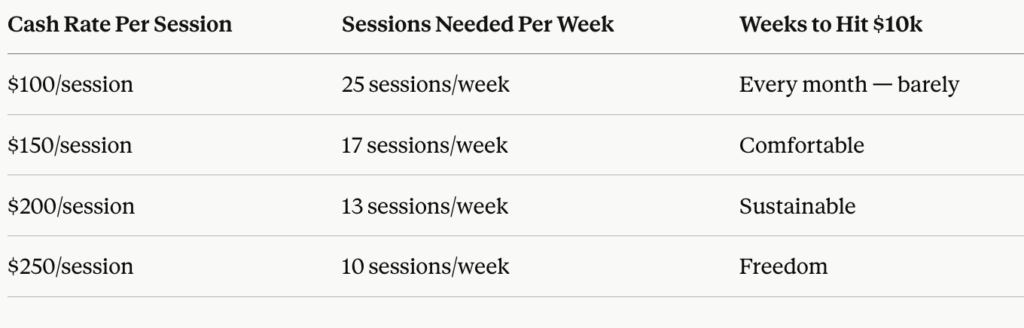
At $200 a session — a realistic cash-based rate for a pelvic PT in most US markets — you need 13 sessions a week to hit $10,000. That is not a grind. That is a part-time schedule at a premium rate.
Furthermore, that math assumes zero packages, zero group offerings, and zero recurring wellness revenue. Add any of those and you hit $10k with even fewer one-on-one hours. The number is not the ceiling. The number is the floor.
Why Most Providers Never Hit It
The $10k month is achievable. So why do most pelvic providers never get there?
Three reasons. First, they underprice. At $90 a visit — the average insurance reimbursement — you need 28 visits a week just to hit $10k gross, before overhead, before taxes, before a single dollar hits your pocket. The model is broken before the work begins.
Second, they wait. They wait until they feel ready, until they have more certifications, until they’ve built a bigger audience, until the timing is better. Consequently, the timing never becomes better on its own. The providers who hit $10k fast are the ones who started before they felt ready.
Third, they don’t have a system. They have hustle. Hustle fills a schedule for 90 days and then burns out. A system fills a schedule indefinitely — because it runs on referrals, retention, and a clear patient pathway, not on willpower.
The 4 Pillars of a $10k Month
Every pelvic provider who hits $10k months consistently has four things in place. Not six. Not twelve. Four.
Pillar 1: Pricing That Makes the Math Work
First and most importantly — your rate has to make $10k achievable at a sustainable session volume. If you need more than 20 sessions a week to hit your number, your rate is too low.
Start by calculating your minimum viable rate: your monthly overhead plus your desired take-home, divided by the number of sessions you want to see. That’s your floor. Your cash rate should sit meaningfully above it.
For most pelvic PTs in mid-to-high cost-of-living markets, a $175–$250 session rate is both justified and achievable. Specifically, providers with a defined niche — postpartum return-to-sport, pelvic pain, pre/post-surgical — routinely charge at the top of that range and beyond. Your niche is not limiting your market. It is expanding your justification for a premium.
Additionally, packages accelerate the math. A 6-session postpartum package at $1,100 collected at intake is $1,100 in revenue before the patient has attended a single appointment. Packages improve cash flow, reduce no-shows, and increase plan of care completion — three retention wins in one pricing decision.
Pillar 2: A Referral Engine That Runs Without You
Second, you need referrals coming in without you manually chasing them every week. Cold outreach and social media content are long games. A referral engine is a short game — and it is the fastest path to a full schedule.
A referral engine has three components. The first is clinical referral partners — OBGYNs, midwives, doulas, lactation consultants, women’s health NPs, and pelvic-aware chiropractors who see your ideal patient before you do. One strong OBGYN relationship can send 5–10 patients a month indefinitely. That is your schedule, built on a single relationship.
The second component is patient referrals — which require a structured ask, not a passive hope. Ask at the peak outcome moment, make it frictionless, and follow up with every patient who refers. For a deeper breakdown of building your OBGYN referral network specifically, read Pelvic Health OBGYN Referrals.
The third component is digital presence — not viral content, but findability. A Google Business Profile with recent reviews, a website that ranks for your niche keywords, and a consistent Instagram presence that signals you are active and credible. You don’t need 10,000 followers to hit $10k months. You need to be findable when the right patient is looking.
Pillar 3: A Discovery Call That Converts
Third, you need a discovery call process that converts inquiries into booked patients. A full referral pipeline means nothing if patients drop off between inquiry and intake.
The discovery call is not a consultation. It is not a free session. It is a structured 15–20 minute conversation with a clear framework — understand the patient’s situation, connect their pain to your solution, present the investment, and ask for the booking.
Most providers lose patients on the discovery call not because the patient can’t afford it, but because the provider doesn’t ask. They present the rate, answer questions, and then say “think it over and let me know.” That is not a close. That is an invitation to disappear.
Therefore, end every discovery call with a direct question: “Based on what you’ve shared, I think we can get you to [their goal] in [timeframe]. I’d love to get you started — are you ready to book your first session?” Silence is not rejection. Silence is a patient who needs one more beat of confidence from you.
For a complete discovery call framework, read Pelvic Health Discovery Call — the script and structure that consistently converts warm leads into booked intakes.
Pillar 4: A Retention System That Compounds
Fourth, retention turns a $10k month into a repeatable $10k month. Without retention, you are refilling your schedule from scratch every 4–6 weeks. With retention, your baseline grows every month because previous patients keep returning, referring, and compounding your revenue.
Specifically, three retention levers matter most on the path to $10k. First, plan of care completion — patients who complete their full recommended visits generate significantly more revenue and significantly more referrals than patients who drop off early. Second, a post-discharge follow-up sequence that brings patients back for maintenance visits. Third, a wellness tier that gives healthy, discharged patients a reason to stay connected.
A retained patient at $150/month in a quarterly maintenance package is $1,800 a year in recurring revenue from a single patient relationship. Ten of those patients is $18,000 a year before you see a single new intake.
Moreover, retained patients refer at 4.5x the rate of one-time patients. Retention does not just protect revenue. It generates it. For the full retention blueprint, read Client Retention for Pelvic Experts.
The 90-Day Path to Your First $10k Month
Here is what the first 90 days look like when the four pillars are in place.
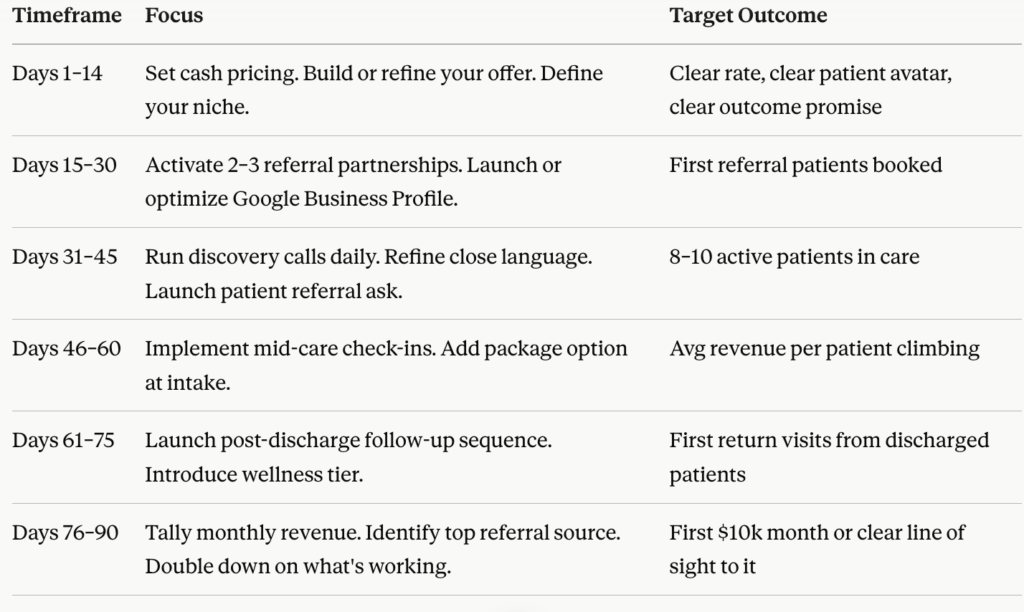
This is not a theory. This is the sequence that providers inside PelviBiz follow — with coaching, accountability, and a system built specifically for the pelvic health niche.
What $10k Months Actually Feel Like
Here is what changes when you consistently hit $10k months as a pelvic provider.
You stop doing math on Sunday nights to figure out if you can cover payroll. You stop accepting patients who aren’t a good fit because you need the revenue. You stop apologizing for your rate on discovery calls because the number is no longer anxiety-inducing — it’s just accurate.
Furthermore, you start making different decisions. You hire the support staff you’ve been putting off. You invest in the certification you’ve been eyeing. You take a Friday off without your income falling apart.
Additionally, $10k months are not the finish line. They’re the proof of concept. The providers who hit $10k consistently almost always hit $15k within two quarters — because the systems that generate $10k are the same systems that generate $15k. You just turn up the volume.
The ceiling is not $10k. The ceiling is whatever you decide to build toward. However, $10k is where the game changes — and where most providers realize the only thing that was ever in the way was the model they were operating inside.
Common Mistakes That Delay the $10k Month
Even motivated providers stall out. Here are the most common reasons — and the fix for each.
Waiting to niche down. Providers who try to serve everyone fill their schedule slowly because no one refers to a generalist. Fix: pick one population, one outcome, and own it for 90 days.
Underpricing and overworking. Seeing 25 sessions a week at $100 is not a business. It’s a job with worse hours and no PTO. Fix: raise your rate to the point where 15 sessions a week generates your target revenue.
Skipping the discovery call framework. Warm leads who ghost are almost always a discovery call problem. Fix: script the call, practice the close, and track your conversion rate weekly.
No referral system. Relying on Instagram alone to fill a schedule is slow and unpredictable. Fix: identify two OBGYN or women’s health providers in your market and have a conversation this week.
Treating retention as an afterthought. If you’re refilling your schedule from zero every month, you’re working twice as hard as you need to. Fix: implement the post-discharge sequence and watch your baseline rise.
The Bottom Line
Your first $10k month is a math problem. The math works at $175–$250 a session. The schedule is sustainable at 13–17 visits a week. The referrals come from two or three strong partnerships. The retention comes from a 3-touch follow-up sequence that takes 30 minutes to build.
None of this requires a massive audience, a viral reel, or ten years in private practice. It requires a clear rate, a referral engine, a discovery call that closes, and a retention system that compounds.
Furthermore, it requires deciding that you are done building someone else’s practice on someone else’s terms at someone else’s rate.
The providers who hit $10k months are not smarter than you. They are not more credentialed than you. They simply stopped waiting and started building. Moreover, they had the right system behind them when they did.
If you’re ready to have that system, read Healthcare Provider Private Practice for the full private practice launch framework — or book your Growth Assessment below and let’s build it together.
Frequently Asked Questions
How long does it take to hit $10k months as a pelvic health provider?
Most providers inside PelviBiz reach their first $10k month within 60–90 days of implementing the four pillars: cash pricing, a referral engine, a converting discovery call, and a retention system. The timeline depends on starting point — whether you’re launching from scratch or transitioning an existing panel — but the 90-day window is realistic for most providers who implement consistently.
How many patients do I need to see to make $10k a month as a pelvic PT?
At a $200 cash rate, you need 50 sessions a month — roughly 13 sessions a week. At $250, you need 40 sessions a month — 10 per week. Packages and group offerings reduce the one-on-one session count further. The key is pricing correctly so the math works at a sustainable volume.
Can a pelvic floor PT really make $10k a month in private practice?
Yes — and many make significantly more. The cash-based pelvic health model is one of the strongest in outpatient PT because of the specificity of the niche, the underserved nature of the population, and the high willingness to pay out of pocket for outcomes that insurance-based care consistently fails to deliver.
What is the fastest way to fill a cash-based pelvic health schedule?
The fastest path is referral partnerships — specifically with OBGYNs, midwives, doulas, and women’s health NPs who see your ideal patient first. A single strong referral partner can send 5–10 patients a month. Combine that with a Google Business Profile optimized for your niche and a structured discovery call process, and most providers see a materially full schedule within 60 days.