Nobody talks about retention. Everyone talks about leads.
Getting new patients is exciting. It feels like growth. It shows up in your ad metrics and your DM count and your discovery call calendar. However, the providers who actually scale — the ones hitting $20K, $30K, $50K cash months — aren’t just generating leads. They’re keeping the patients they already have.
Client retention is the single highest-ROI activity in a cash-based pelvic practice. A retained patient costs you nothing to acquire. They already trust you. They’ve already experienced your outcomes. Furthermore, they refer. A single retained patient who refers two friends is worth more than five cold leads who never book.
Most pelvic providers don’t have a retention problem. They have a retention system problem. The care is exceptional. The follow-through infrastructure isn’t there. This blueprint fixes that
Why Client Retention Is Different in Cash-Based Pelvic Care
In an insurance-based model, retention is somewhat built in. Patients keep coming back because their plan covers it, their doctor orders more visits, and the system handles the scheduling. Cash-based is different. Every return visit is a conscious, discretionary decision. The patient is choosing to spend real money — again — because the value is clear enough to justify it.
That means retention in a cash-based practice is not passive. It is actively earned at every touchpoint — the first session, the follow-up sequence, the discharge conversation, and everything in between.
Furthermore, pelvic health has a unique retention dynamic. Many patients come in for a specific acute issue — postpartum recovery, prolapse, pre-surgical prep — and once that issue resolves, they feel “done.” Consequently, the provider who doesn’t build a wellness or maintenance pathway loses that patient permanently. The provider who does keeps them for years.
The goal is not to keep patients dependent on care. The goal is to keep patients connected to their health — and to you as the expert who understands it.
The 5-Stage Client Retention Blueprint
Client retention doesn’t happen at discharge. It starts at intake. Here are the five stages every pelvic health provider needs in place.
Stage 1: The Onboarding Experience (Sessions 1–2)
First impressions set retention expectations. The patient who feels understood, seen, and oriented in their first two sessions is far more likely to complete their full plan of care — and return afterward.
Specifically, three things need to happen in sessions one and two. First, give the patient a written care roadmap. Show them where they are, where they’re going, and how many sessions it realistically takes. Patients who understand the timeline stay in it. Second, name their goal in their language, not yours. “Return to running postpartum” lands harder than “improve lumbopelvic stability.” Third, send a same-day follow-up message — a simple check-in that shows you’re thinking about them between appointments.
Additionally, ask one question at the end of session two: “What would make this feel worth every penny?” The answer tells you exactly what to deliver.
Stage 2: The Mid-Care Check-In (Sessions 3–5)
This is where most providers lose patients. The initial excitement has worn off. Progress feels slower than expected. Life gets busy. Without a structured mid-care touchpoint, drop-off spikes here.
Therefore, build a formal mid-care check-in into your intake protocol — not as a clinical milestone, but as a relationship touchpoint. Review their goal. Celebrate any progress, even small. Reframe setbacks as part of the process, not a sign the treatment isn’t working.
Moreover, use this moment to introduce what comes next. If the patient is 60% through their plan of care, start planting the seed for a maintenance or wellness phase. Don’t wait until session eight to mention it. By then, they’ve already mentally checked out.
Stage 3: The Discharge Conversation (Final Session)
Most providers treat discharge as the end of the relationship. It’s actually the highest-leverage retention moment in the entire patient journey.
The discharge conversation has three components. First, celebrate the outcome explicitly. Name what changed. Quantify it where you can — return to running, pain from a 7 to a 1, lifting their toddler without leaking. Second, give them a maintenance recommendation with a specific interval. “I’d love to see you every 6–8 weeks for a tune-up” is far more retentive than “come back if things flare up.” Third, ask for the referral directly. “If you know anyone dealing with something similar, I’d love for you to send them my way.”
Consequently, the provider who handles discharge well doesn’t lose patients. They convert them into a maintenance base and a referral engine simultaneously.
Stage 4: The Post-Discharge Follow-Up Sequence
The relationship doesn’t end when the patient walks out. It continues through a structured follow-up sequence that keeps you top of mind without being pushy.
Here’s a simple 3-touch sequence that works:
Week 2 post-discharge: A personal check-in message. “Hey [name], just thinking about you — how are things feeling two weeks out?” No CTA. Just care.
Week 6 post-discharge: A value-add message. Send a relevant tip, article, or exercise that connects to their specific goal. This reinforces your expertise and reminds them why they came to you.
Week 10 post-discharge: A soft re-engagement. “It’s been about 10 weeks — this is usually when patients notice a few things starting to drift. Want to book a tune-up session?” Specific, timely, low-pressure.
Furthermore, automate this sequence in your CRM or practice management software. It takes 30 minutes to set up and runs indefinitely. The providers inside PelviBiz who implement this sequence report a 30–40% increase in return visits within 90 days.
Stage 5: The Wellness and Maintenance Pathway
This is the stage most pelvic providers skip entirely — and it’s where the consistent revenue lives.
A wellness pathway converts discharged patients into recurring revenue without requiring new patient acquisition. It can look like a monthly maintenance visit, a quarterly check-in package, a group class or workshop series, or a telehealth wellness check-in for patients who’ve moved out of your area.
Specifically, the key is to position wellness care as proactive, not reactive. The patient who comes in for a tune-up every 6 weeks is not a patient who needs you. She’s a patient who values herself enough to invest in staying well. That reframe changes the entire dynamic of the conversation.
Additionally, package your wellness offering. A “Pelvic Wellness Maintenance Plan” at $300/quarter sounds like a program. Three individual visits at $100 each sounds like a cost. Same math, very different psychology.
Client Retention by the Numbers
Here’s what retention does to your revenue model compared to a pure new-patient acquisition strategy:
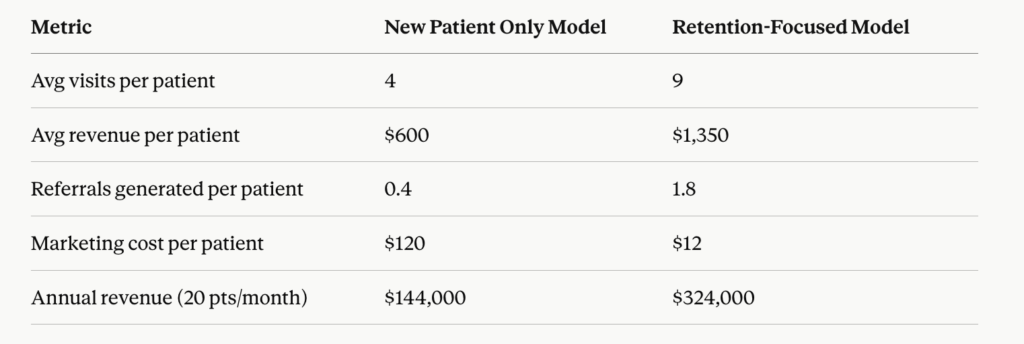
The math is not subtle. A retention-focused model with the same new patient volume generates more than double the revenue — because every patient is worth more and costs less to keep.
The Retention Metrics Every Pelvic Provider Should Track
You cannot improve what you don’t measure. Therefore, start tracking these four numbers monthly:
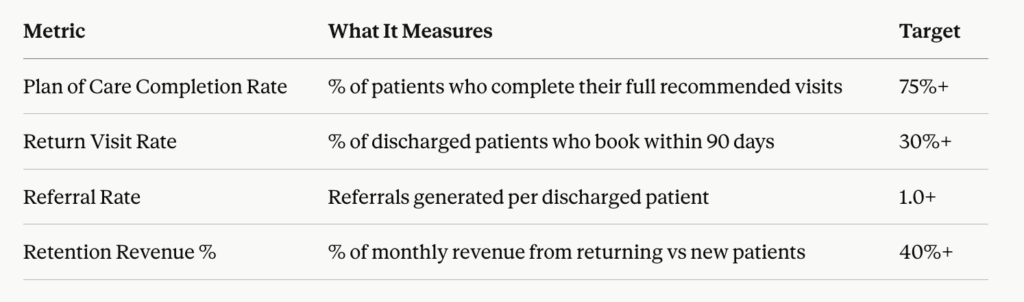
If your plan of care completion rate is below 75%, your mid-care check-in needs work. If your return visit rate is below 30%, your discharge conversation needs work. If your referral rate is below 1.0, your outcomes aren’t being celebrated loudly enough.
What Kills Retention (And How to Fix It)
Even excellent clinicians lose patients for non-clinical reasons. Here are the most common retention killers in cash-based pelvic practices — and the fix for each.
No clear care roadmap at intake. Patients who don’t know how long treatment takes drop off when progress feels slow. Fix: give every patient a written timeline at session one.
Discharge without a next step. “Come back if things flare up” is not a retention strategy. Fix: every discharge ends with a specific maintenance recommendation and a pre-booked follow-up or standing invitation.
No follow-up after discharge. Out of sight, out of mind. Fix: implement the 3-touch post-discharge sequence and automate it.
Pricing friction at re-entry. Patients who’ve discharged sometimes hesitate to rebook because they feel they “shouldn’t need to come back.” Fix: normalize return visits as proactive care, not failure. Language matters.
No wellness offering. If there’s no pathway for the healthy, maintained patient, you lose her the moment she feels better. Fix: build and name a wellness tier — even something simple works.
Building Your Referral Loop Inside Retention
The highest-retention practices aren’t just retaining patients. They’re turning retained patients into a referral engine.
A patient who completes their full plan of care and achieves their goal is sitting on a story. She knows what it felt like before. She knows what changed. However, she won’t tell that story unless you give her a prompt and make it easy.
Therefore, three things need to be in place. First, ask for the referral at the peak of outcome celebration — not at discharge paperwork, but in the moment when she says “I can’t believe how different I feel.” That’s your window. Second, make referral frictionless. A simple message she can forward, a link to your booking page, a Google review request — whatever fits your workflow. Third, follow up when she refers. A personal thank-you note to a patient who sent you a referral costs two minutes and builds loyalty that no ad campaign can buy.
For more on building a referral network beyond your existing patients, read Pelvic Health OBGYN Referrals — the framework for building referral partnerships with OBGYNs and women’s health providers.
Additionally, if you’re tracking your leads and referral sources but not seeing conversions, Pelvic Health Discovery Call breaks down exactly how to convert a warm referral into a booked patient.
Finally, if retention is dialed in and you’re ready to scale, read Scale a Healthcare Practice for what comes after the foundation is built.
The Bottom Line on Client Retention
New patients are exciting. Retained patients are profitable.
The cash-based pelvic practices that hit consistent five-figure months aren’t running endless cold ad campaigns. They’re working a system — one that starts before the first session, runs through discharge, and keeps the relationship alive long after the acute episode resolves.
Moreover, retention is not manipulation. It’s not keeping patients in care they don’t need. It’s building a practice where patients stay connected to their health, return proactively, and send everyone they know. That’s the practice worth building.
You already deliver outcomes worth staying for. Furthermore, now you have the system to make sure patients actually stay.
Frequently Asked Questions
What is client retention in a cash-based pelvic health practice?
Client retention in a cash-based pelvic practice means keeping patients engaged beyond their initial plan of care — through completed treatment, return visits, wellness maintenance, and referrals. It is the single highest-ROI activity in a cash-pay model because retained patients cost nothing to acquire and generate referrals at significantly higher rates than one-time patients.
How do I improve patient retention in my pelvic health practice?
Start with five systems: a clear care roadmap at intake, a mid-care check-in between sessions three and five, a structured discharge conversation with a specific next-step recommendation, a 3-touch post-discharge follow-up sequence, and a named wellness maintenance pathway for patients who’ve completed their acute care.
What is a good patient retention rate for a cash-based PT practice?
Target a plan of care completion rate of 75% or higher and a 90-day return visit rate of 30% or higher. If your retention revenue — revenue from returning patients versus new patients — is below 40% of your monthly total, your retention systems need attention.
How do retained patients affect revenue in a pelvic health practice?
Significantly. A retention-focused model generates an average of $1,350 per patient versus $600 in a new-patient-only model — with a marketing cost of $12 per patient versus $120. At the same new patient volume, a retention-focused practice can generate more than double the annual revenue.