Most pelvic health providers undercharge. Not because their work isn’t worth more — but because nobody taught them how to price it.
PT school covers anatomy, biomechanics, and clinical reasoning. It does not cover how to set a rate, defend it to a patient, or build a pricing model that sustains a business. So providers default to whatever insurance pays — and then wonder why they’re burning out at 35 visits a week.
Cash-based pricing changes that equation. However, getting there requires more than just picking a higher number. It requires a framework, a mindset, and the language to back it up.
Why Most Pelvic Providers Underprice Their Services
The insurance system trained you to accept what you’re given. For years, a third party told you what your evaluation was worth — and you submitted the claim, accepted the adjudication, and moved on. That conditioning runs deep.
Furthermore, there’s the guilt factor. Many providers feel uncomfortable charging patients directly, especially when those patients have been in pain for years and are already stretched thin. The instinct to help overrides the instinct to be paid fairly for the help.
Consequently, providers set rates that feel “safe” — low enough that no one will push back, but also low enough that the business doesn’t work. That’s not sustainable, and it’s not the only option.
The providers who charge confidently aren’t the ones who care less about their patients. They’re the ones who’ve done the math and know exactly what their service delivers.
The 3-Part Cash-Based Pricing Framework
Confident pricing isn’t a gut feeling. It comes from a framework with three components — and every provider building a cash-based practice needs all three.
1. Cost-Based Floor
First, calculate what it costs you to deliver a session. This includes your overhead (rent, supplies, software, insurance), your time (including admin, documentation, and travel if applicable), and your desired salary. Divide that by the number of sessions you can realistically see in a week. That number is your floor — the minimum you need to charge to break even.
Most providers are shocked to find their insurance reimbursements don’t clear this floor.
2. Market-Based Range
Second, research your market. What are other cash-based providers charging in your metro area or in your telehealth footprint? Look specifically at providers with similar credentials and specialties. This gives you a realistic range — not a ceiling, but a reference point.
Additionally, check what wellness providers nearby are charging. Functional medicine doctors, integrative NPs, and cash-pay chiropractors often set the frame for what your local market expects to pay for premium out-of-pocket healthcare.
3. Value-Based Premium
Third — and most importantly — price for outcomes, not time. A 45-minute session that resolves postpartum pelvic pain and gets a patient back to running is not worth the same as a 45-minute session of generic exercise instruction. Your niche, your outcomes data, and your clinical depth all justify a premium.
Therefore, providers with documented outcomes, strong referral networks, or a narrow specialty can — and should — price above the market average. Value-based pricing is how cash-based practices scale.
What Cash-Based Pricing Actually Looks Like: A Rate Comparison
Here’s what the math looks like when you compare insurance reimbursement to realistic cash-based rates in the pelvic health space:
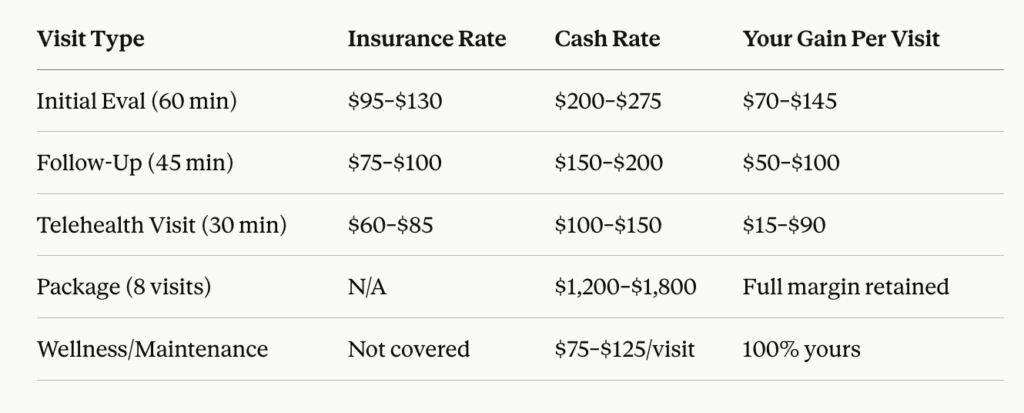
At 20 cash-pay sessions per week versus 35 insurance sessions, the revenue difference is significant — and the schedule difference is life-changing. Specifically, providers inside PelviBiz consistently report working fewer hours at higher take-home income within 90 days of making the switch
How to Say Your Price Without Flinching
Knowing your rate is one thing. Saying it out loud — especially on a discovery call — is another. Most providers stumble here not because they don’t know their number, but because they haven’t practiced it.
The rule is simple: say the price, then stop talking. Don’t apologize. Don’t immediately offer a discount. Don’t fill the silence with qualifications. State the investment, let the patient absorb it, and wait.
“The investment for a 6-session postpartum return-to-sport package is $1,200. That includes your initial evaluation, five follow-up sessions, and a home program. Would you like to get started?”
That’s it. No hedging. No “I know it’s a lot.” No sliding scale mention before they’ve even asked. You’ve stated the value — now let the patient respond.
Moreover, your confidence is clinical data. If you waver on your price, patients read it as uncertainty about your outcomes. Steady pricing signals steady expertise.
Handling the Most Common Price Objections
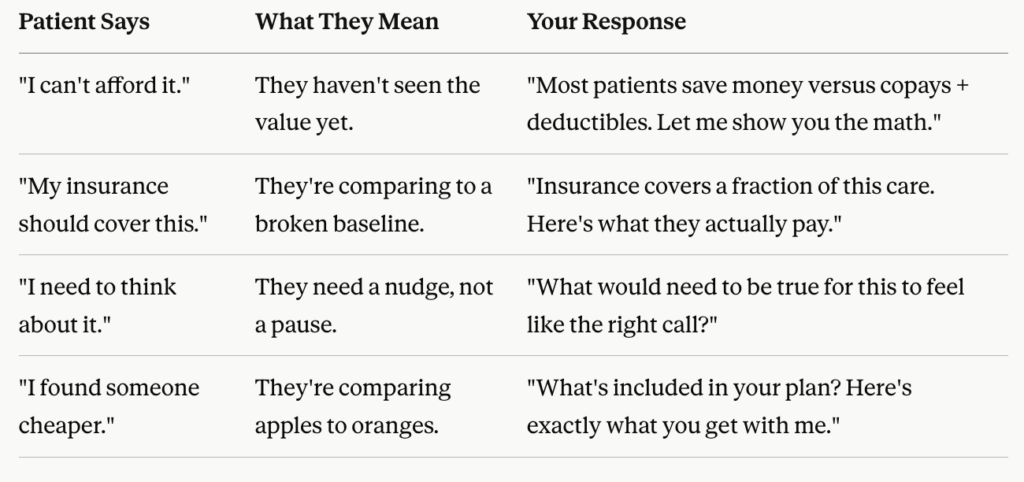
The goal in every objection is to redirect the conversation from price to value. Subsequently, the patient who asks about cost isn’t rejecting you — they’re asking you to help them justify the decision. Meet them there.
When to Raise Your Rates
You should raise your rates when your schedule is consistently full at your current rate. If you’re booking out more than 2 weeks and turning patients away, you’re underpriced.
Additionally, raise rates when you add certifications, niche depth, or documented outcomes data. Your pricing should evolve with your expertise. Staying flat while your clinical skill grows is a choice to leave money on the table.
Finally, raise rates annually — at minimum. Even a 5–10% annual increase keeps pace with inflation and signals a practice that’s growing, not stagnating.
For more on building the business systems around your pricing, read How to Build Authority as a PT Entrepreneur.
And if you’re still deciding whether to make the full cash-based pivot, start with Insurance to Cash Pay — the framework that walks you through the transition.
Already running a cash-based practice? Read Scale a Healthcare Practice to see what comes next.
The Bottom Line on Cash-Based Pricing
Confident pricing is a skill. Like all clinical skills, it improves with repetition, feedback, and a solid framework underneath it. The providers who get there fastest aren’t the ones who’ve been in practice longest — they’re the ones who stopped waiting for someone to give them permission to charge what they’re worth.
You built the expertise. You deliver the outcomes. Furthermore, your pricing should reflect both.
The cash-based model works because it puts you back in control — of your schedule, your patient population, and your income. However, it only works if you’re willing to name your price and stand behind it.
Frequently Asked Questions
How do I set my cash-based pricing as a pelvic health provider?
Start with a 3-part framework: calculate your cost-based floor (overhead + time + salary target), research your market range, and then price for the value of your outcomes. Most pelvic PTs starting cash-based should aim for $150–$250 per session depending on market, niche, and experience level.
What is a good cash-based rate for a pelvic floor physical therapist?
In most US markets, cash-based pelvic PTs charge between $175 and $275 for an initial evaluation and $125 to $200 for follow-up sessions. Providers in high-cost-of-living metros or with specialized niches — postpartum, pelvic pain, return-to-sport — often charge at the top of that range or above it.
How do I handle patients who say my cash-based prices are too high?
Redirect from price to value. Help the patient understand what’s included, what outcomes they can expect, and what the true cost of staying in pain or cycling through insurance visits actually is. Most price objections are value gaps — not budget limits.
When should I raise my cash-based rates?
Raise your rates when your schedule is consistently full, when you add specialized training or certifications, and at minimum annually to keep pace with inflation. A full schedule at your current rate is the clearest signal you’ve left room on the table.