Ask a cash-based practice owner what they charge for an initial evaluation, and they’ll answer in seconds. Ask the same provider what they paid themselves last month, and the room goes quiet.
This isn’t a knowledge gap. It’s a permission gap. Consequently, learning to pay yourself practice income on a fixed, intentional schedule is one of the most overlooked skills in healthcare entrepreneurship — and one of the fastest ways to burn out even a profitable business.
Why Providers Underpay Themselves
First, most healthcare providers were trained clinically, not financially. Second, guilt plays a bigger role than most owners admit — it can feel selfish to pay yourself well while reinvesting in a growing business. Third, without a system, “paying yourself” becomes whatever’s left over after every other bill clears, which in a growing practice is often nothing.
This is backwards. Your paycheck should be a planned expense, not a leftover.
The Three Numbers Every Practice Owner Needs
1. Owner’s Pay — Your actual salary, hitting your personal account on a fixed schedule regardless of a slow month. Specifically, treat it as a non-negotiable business expense, the same way rent or payroll is.
2. Profit — After owner’s pay and operating expenses, what’s left is profit. Therefore, profit should be a deliberate percentage you set aside, not an afterthought you discover at tax time.
3. Reinvestment — The remainder funds growth — hiring, marketing, equipment, or systems. However, reinvestment should never come out of your own paycheck; it comes out of what’s left after you’ve already paid yourself.
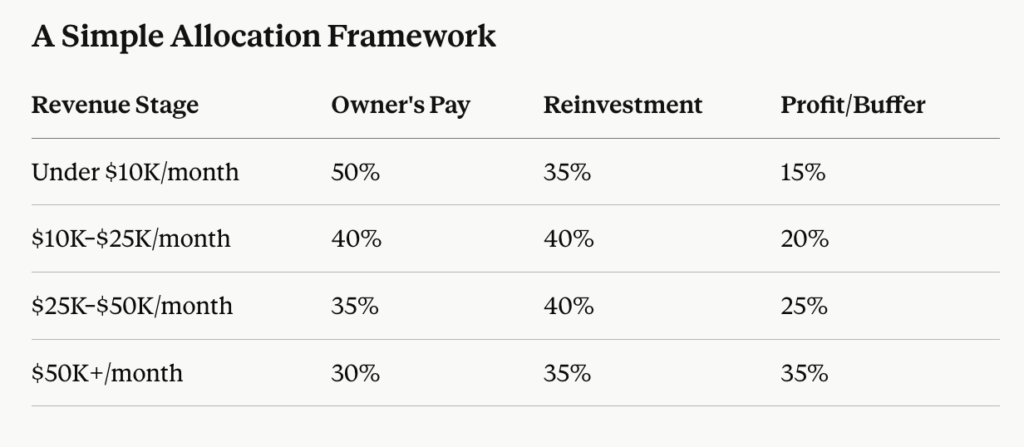
These percentages shift as revenue grows because early on, your paycheck needs to be protected first — otherwise burnout ends the business before it ever scales.
The Exit Story Nobody Talks About
Most healthcare business content stops at “how to grow.” Rarely does it address what happens at the other end — what your practice is actually worth, and what it looks like to eventually sell it or step back from daily patient care.
Dr. Kelly Alhooie built a 7-figure cash-based practice and later sold it. That transition doesn’t happen for owners who never separated their personal pay from business profit in the first place — because you can’t sell what you can’t clearly measure.
Research from the U.S. Small Business Administration (sba.gov) consistently shows that businesses with clean, separated owner compensation and documented profit margins are significantly more attractive — and valuable — to eventual buyers. Similarly, workplace financial wellbeing data from Gallup links inconsistent personal pay directly to higher reported burnout among small business owners.
How to Start This Month
First, calculate your average monthly take-home over the last six months — most owners are surprised by the number. Second, set a fixed owner’s pay amount based on your current revenue stage using the table above. Third, automate the transfer so it happens whether or not you feel like the month was “good enough” to deserve it. If pricing is part of what’s holding your numbers back, our cash pay pricing guide (link: /cash-pay-pricing) is the place to start, and our piece on the transition from insurance to cash pay (link: /insurance-to-cash-pay) covers the revenue shift that usually makes this conversation possible in the first place.
FAQ
How much should I pay myself as a new practice owner?
Under $10K/month, allocate roughly 50% to owner’s pay as a fixed, non-negotiable expense.
What if a slow month means I can’t pay myself the full amount?
Build a profit buffer during stronger months specifically to protect your pay during slower ones.
Should I pay myself the same amount every month?
Yes — a fixed, scheduled amount creates financial stability and prevents burnout.
How does owner pay affect what my practice is worth if I sell?
Clean separation between personal pay and profit makes true profitability visible, which increases buyer confidence and valuation.
Book Your Free Growth Assessment → https://preview.pelvibiz.com/widget/bookings/pelvibiz/getyourproblemsolved
Internal links: /cash-pay-pricing, /insurance-to-cash-pay, /dr-kelly-alhooie
External links: sba.gov, gallup.com