You didn’t go into healthcare to become a systems architect. But if you own a cash-based practice — pelvic health, chiropractic, nurse practitioner-led, mental health, or med spa — that’s exactly what you are now, whether you signed up for it or not.
Most business coaching built for providers assumes you’re a physical therapist. Yours doesn’t have to. The healthcare business systems that turn a struggling solo practice into a predictable, scalable business are specialty-agnostic. Patients change. The systems don’t.
Why “PT Advice” Doesn’t Always Translate
Most cash-based business content online is written by and for physical therapists. If you’re a nurse practitioner running a functional medicine practice, or a chiropractor building a cash membership model, that advice can feel like it wasn’t built for you.
It wasn’t. However, the underlying business mechanics are identical across specialties. Furthermore, the providers who scale fastest are the ones who stop looking for niche-specific hacks and start building four core systems instead.
The Four Systems Every Cash-Based Practice Needs
1. A Patient Acquisition System
Referral relationships, in-person community building, and organic content all outperform paid ads for most cash-based providers. Specifically, this means a repeatable weekly rhythm — not a one-time marketing push. Our guide on building a referral system (link: /pelvic-health-obgyn-referrals) outlines the exact framework, and the mechanics apply whether your referral source is an OB, an orthopedic surgeon, a primary care office, or a corporate wellness program.
2. A Pricing System
Undercharging is the single most common reason cash-based practices stall. Consequently, your rates need to reflect your expertise, not your discomfort saying a number out loud. Our cash pay pricing framework (link: /cash-pay-pricing) was built for pelvic health, but the psychology and math behind it apply to any specialty charging out of pocket.
3. A Delegation System
Every provider we’ve coached past $30K months has one thing in common: they stopped being the bottleneck. Therefore, hiring, training, and documenting your process early — even before you think you’re “big enough” — is what makes growth possible at all.
4. A Retention System
Acquiring a new patient costs significantly more than keeping one. As a result, your follow-up sequence, re-engagement touchpoints, and patient experience matter as much as your marketing.
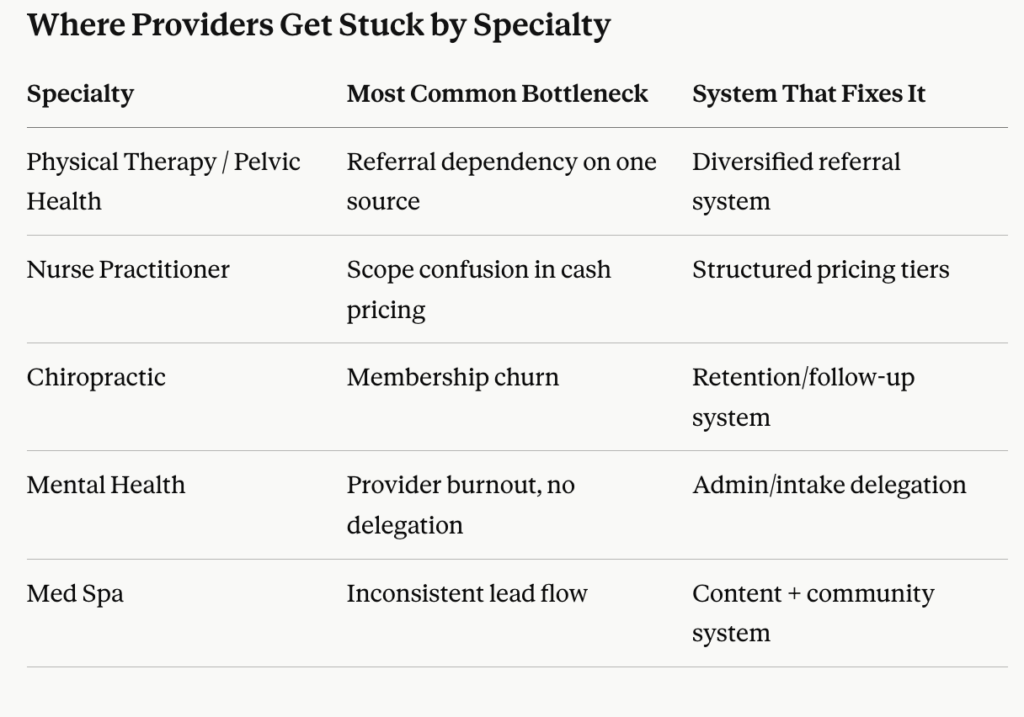
Where Providers Get Stuck by Specialty
The Mindset Shift That Actually Matters
Specifically, the providers who scale fastest stop thinking like a specialist and start thinking like a CEO. This doesn’t mean abandoning clinical excellence. It means recognizing that clinical skill fills a room once, but business systems fill it every week.
According to the Medical Group Management Association (mgma.com), practices with documented operational workflows consistently report higher per-provider revenue than those without. Similarly, workforce data from the Bureau of Labor Statistics (bls.gov) shows continued growth across nearly every outpatient healthcare specialty — meaning the opportunity for cash-based models is expanding well beyond physical therapy.
Where to Start If You’re Not a PT
First, audit which of the four systems is weakest in your practice today. Second, fix the pricing system before the acquisition system — more traffic into a weak pricing structure just means more undercharging, faster. Third, build your delegation system earlier than feels comfortable. Finally, revisit our guide on what to look for in healthcare business coaching (link: /best-healthcare-business-coaching) to evaluate whether your next mentor actually understands your specialty or is just repackaging PT advice.
FAQ
Do these systems really work outside of pelvic health and physical therapy?
Yes. The four systems are built on business mechanics, not clinical protocols, which is why they transfer across specialties.
I’m a nurse practitioner. Where should I start?
Start with your pricing system — NPs most often struggle with confidently pricing cash services relative to scope.
How long does it take to see results?
Providers with the full framework in place report reaching their first $10K month in an average of 5 months, versus 14 months without any documented systems.
Is healthcare business coaching worth it if I’m not a PT?
It depends on whether the coach understands your specialty’s referral ecosystem and pricing psychology. See: /best-healthcare-business-coaching
Book Your Free Growth Assessment → https://preview.pelvibiz.com/widget/bookings/pelvibiz/getyourproblemsolved
Internal links: /pelvic-health-obgyn-referrals, /cash-pay-pricing, /best-healthcare-business-coaching
External links: mgma.com, bls.gov