Pelvic PT AI tools are now one of the most searched topics among healthcare practitioners — and for good reason. There are hundreds of AI tools marketed to pelvic health providers right now. Most of them are fine. A few are excellent. Additionally, a small number can create real problems if you use them without understanding the guardrails. This is the honest, opinionated breakdown — the specific pelvic PT AI tools PelviBiz recommends, the prompts that actually work, and the non-negotiable ethical principles every practitioner needs before pressing generate.
Why Pelvic PT AI Tools Are Different From General AI Tools
First, it is important to understand why pelvic health practitioners need a different framework for evaluating AI tools than general business owners do.
Pelvic health sits at the intersection of clinical care, patient vulnerability, and sensitive health topics. Furthermore, the content pelvic PTs produce — educational posts, patient communications, social media content — touches on conditions that patients have often been embarrassed to discuss with anyone, including their own doctor. Therefore, the ethical stakes of AI-generated content in this niche are higher than in most other practice areas.
Additionally, pelvic PT AI tools must be evaluated against two standards simultaneously — clinical accuracy and HIPAA compliance. Content that is clinically inaccurate can cause real harm. Content that inadvertently reveals patient information can create legal liability. The framework in this guide addresses both.
According to the American Physical Therapy Association, AI use in clinical documentation and patient communication is a growing area of professional practice that requires practitioner judgment and oversight at every stage. Therefore, the tools are powerful — but the practitioner remains responsible for everything that goes out under their name.
The PelviBiz-Recommended Pelvic PT AI Tool Stack
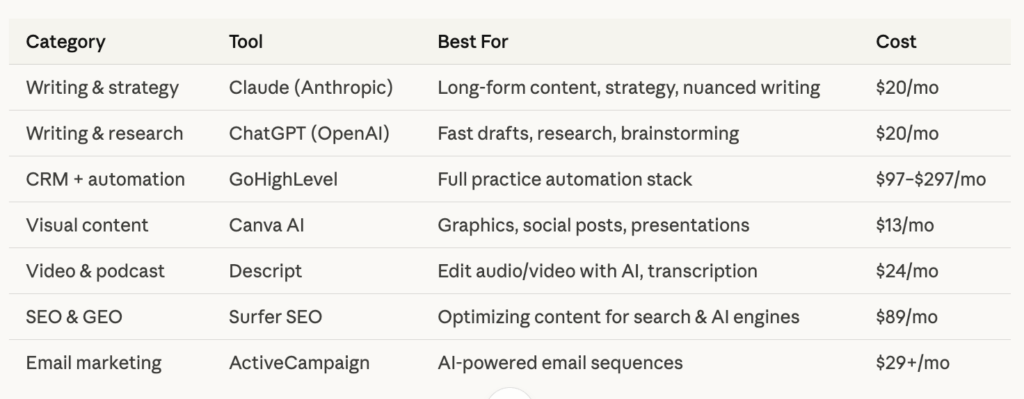
Second, after testing dozens of tools with hundreds of pelvic health practitioners, PelviBiz has a clear set of recommendations for the specific pelvic PT AI tools that deliver the best results in this niche.
| Category | Tool | Best For | Monthly Cost |
|---|---|---|---|
| Writing and strategy | Claude (Anthropic) | Long-form content, strategy, nuanced clinical writing | $20/mo |
| Writing and research | ChatGPT (OpenAI) | Fast drafts, research, brainstorming | $20/mo |
| CRM and automation | GoHighLevel | Full practice automation stack | $97–$297/mo |
| Visual content | Canva AI | Graphics, social posts, presentations | $13/mo |
| Video and podcast | Descript | Audio and video editing, transcription | $24/mo |
| SEO and GEO | Surfer SEO | Optimizing content for search and AI engines | $89/mo |
| Email marketing | ActiveCampaign | AI-powered email sequences and automation | $29+/mo |
Furthermore, you do not need all of these simultaneously. Start with one writing tool and one automation tool. Master both before adding additional pelvic PT AI tools to your stack. Additionally, the best tool is always the one you will actually use consistently — not the most feature-rich option available.
Chart data:
- Writing and content tools: 6.5 hours per week saved
- CRM and scheduling automation: 4 hours per week saved
- Visual content tools: 2 hours per week saved
- Video editing tools: 1.5 hours per week saved
- Email marketing automation: 2.5 hours per week saved
- Title: Pelvic PT AI tools — average weekly time savings by category
- Source: PelviBiz client time tracking data, 2025
The Prompts That Actually Work for Pelvic Health Content
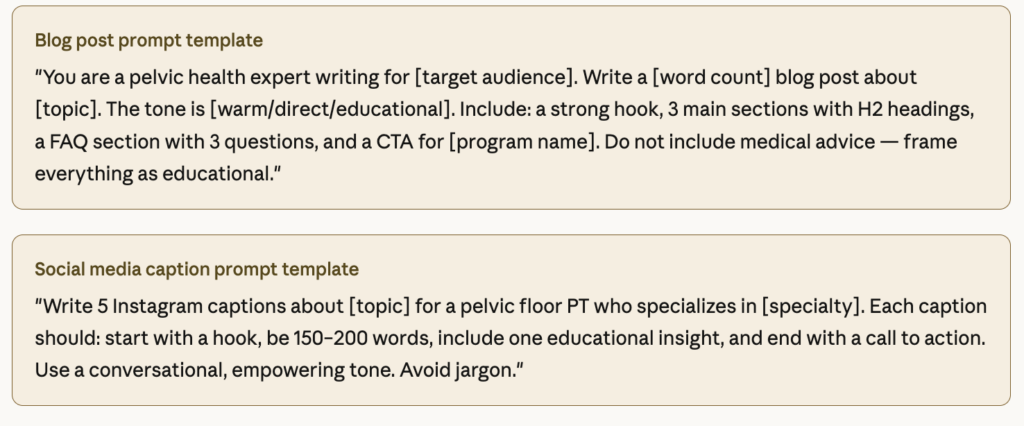
Third, most practitioners who feel underwhelmed by pelvic PT AI tools are using prompts that are too vague. The output quality of any AI tool is directly proportional to the specificity and structure of the prompt. Here are the prompt frameworks PelviBiz teaches inside the Marketing Bootcamp.
Blog Post Prompt Template
“You are a pelvic health expert writing for [target audience — e.g., postpartum athletes returning to sport]. Write a [word count] blog post about [specific topic]. The tone is [warm and direct and educational]. Include a strong opening hook, three main sections with H2 headings, a FAQ section with three questions, and a CTA for [program or offer name]. Do not include medical advice — frame everything as educational content from a pelvic health practitioner perspective.”
Instagram Caption Prompt Template
“Write an Instagram caption for a pelvic health practitioner targeting [specific patient type]. The topic is [specific problem or myth]. The tone is [direct and empathetic]. End with a question that invites comments or a DM invitation. Keep it under 150 words. Do not use medical claims.”
Email Newsletter Prompt Template
“Write a weekly email newsletter for a cash-based pelvic health practice. The subject line should create curiosity without being clickbait. The email should provide one specific educational insight about [topic], share a brief patient story or example without identifying details, and end with one soft CTA pointing to [offer or booking link]. Keep the total length under 300 words.”
Furthermore, the most important prompt skill is iteration — using AI output as a first draft and editing it with your clinical voice and specific patient language. The tool writes the structure. You add the substance that makes it worth reading.
The Non-Negotiable Ethics of Pelvic PT AI Tools
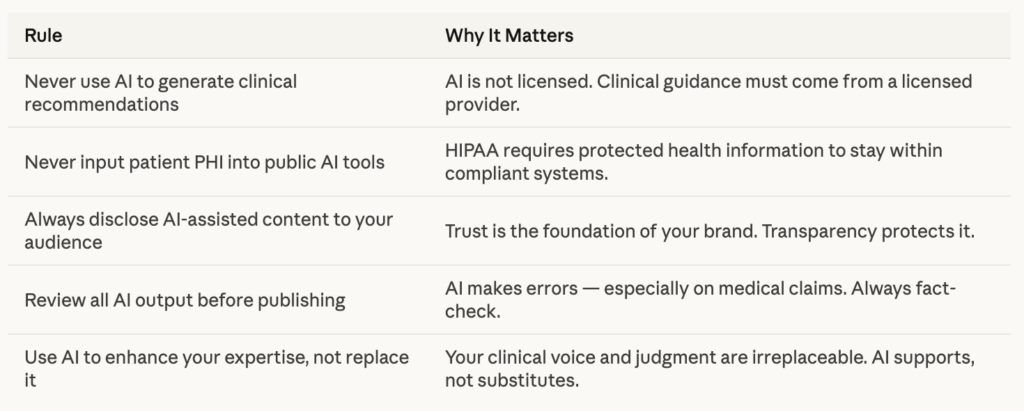
Fourth, the ethical framework for pelvic PT AI tools is not optional. It is the foundation that makes everything else safe to build on. Here are the four principles every pelvic health practitioner must have in place before using AI for any patient-adjacent content.
Principle 1 — Never Use AI for Clinical Advice
AI tools can write educational content about pelvic floor health. They cannot and should not generate individualized clinical recommendations, diagnostic language, or treatment protocols for specific patients. Furthermore, any AI-generated content that could be interpreted as clinical advice must be reviewed and rewritten before publication.
Principle 2 — Never Input Identifiable Patient Information
HIPAA compliance requires that no identifiable patient information — names, dates, specific case details, geographic information that could identify a patient — is entered into any AI tool that stores data externally. Use anonymized, composite, or fictional examples in all AI prompts involving patient scenarios.
Principle 3 — Always Review Before Publishing
Every piece of pelvic PT AI-generated content must be reviewed by a licensed provider before it goes out. This is not optional. You are responsible for the accuracy and appropriateness of everything published under your name — regardless of what tool produced the first draft.
Principle 4 — Disclose AI Use Where Appropriate
While there is no universal legal requirement to disclose AI-assisted content creation in marketing materials, transparency with your audience builds trust. A simple acknowledgment that you use AI tools for content drafting — while your clinical voice and expertise guide every final piece — is an honest and increasingly respected professional standard.
| Application | Safe with AI | Unsafe — Keep Human |
|---|---|---|
| Educational blog content | Yes — with review | No clinical claims |
| Social media captions | Yes — with review | No diagnostic language |
| Email newsletter drafts | Yes — with review | No individualized advice |
| Patient intake responses | Automation only | All clinical content human |
| Treatment plan documentation | No | Always human |
| Clinical decision-making | No | Always human |
| Discovery call conversations | No | Always human |
How Pelvic PT AI Tools Fit Into Your Authority Strategy
Fifth, pelvic PT AI tools are most powerful when they are part of a broader authority-building strategy rather than a standalone content hack. AI produces content faster. However, it is your clinical expertise, your niche positioning, and your consistent presence that turns that content into trust — and trust into booked patients.
Read our complete guide on the authority funnel for practitioners to understand how AI-produced content fits into the full patient acquisition sequence. Additionally, our 90-day authority plan shows you exactly how to build a consistent content system using AI tools month by month.
Furthermore, if you want to understand how AI fits into the broader picture of building a six figure practice, read our dedicated guide on the multi-stream revenue model that PelviBiz clients use to compound income beyond clinical sessions.
Frequently Asked Questions
What are the best pelvic PT AI tools for content creation in 2026? The top pelvic PT AI tools for content creation are Claude for long-form writing and strategy, ChatGPT for fast drafts and research, and Canva AI for visual content. Furthermore, starting with one writing tool and mastering it before adding others consistently produces better results than attempting to use multiple tools simultaneously from day one.
Is it ethical for pelvic health practitioners to use AI tools for patient content? Yes — with clear guardrails in place. AI tools are appropriate for educational content, marketing copy, and administrative communications. They are never appropriate for individualized clinical advice, diagnostic language, or any content involving identifiable patient information. Furthermore, all AI-generated content must be reviewed by a licensed provider before publication.
Do pelvic PT AI tools require technical knowledge to use? No. The learning curve for most pelvic PT AI tools is measured in hours rather than weeks. Furthermore, the prompt frameworks in this post give you a starting point that eliminates the blank page problem immediately. Most practitioners report feeling confident with their primary AI tool within two to three weeks of consistent daily use.
How does PelviBiz teach pelvic PT AI tools and prompting? AI tools, prompt frameworks, and ethical guidelines are integrated throughout PelviBiz coaching programs — including the Marketing Bootcamp. We show practitioners exactly which tools to use, how to prompt them effectively for pelvic health content, and how to maintain the clinical voice that makes AI content convert. Book a free Growth Assessment here.